
Social Media Marketing Ideas for Beauty & Med Spa Businesses
The global medical spa market was valued at roughly $18.61 billion in 2024 and is projected to more than triple by 2034. That growth is exactly why social media for beauty and med spa businesses has gotten harder, not easier. More clinics are posting the same before-and-after photos, the same staff spotlight reels, and the same “book now” captions, and most of them blur together in a scroll. This isn’t a generic list of content ideas. It’s organized around what actually builds trust and bookings for beauty and med spa businesses specifically, plus something most social media guides skip entirely: the consent and disclosure rules that apply the moment a real client’s face ends up in your feed. What Makes Social Media Different for Beauty and Med Spa Businesses Clients scroll a spa or med spa’s Instagram before they ever call, using it to judge results, staff credentials, and cleanliness before trusting anyone with their face or body. That makes social media less about reach and more about evidence. The distinction that matters most, and the one most marketing guides gloss over, is that a beauty salon and a med spa aren’t governed by the same rules. A med spa delivering injectables, laser treatments, or other services under a supervising provider is generally treated as a medical practice, which means client photos can legally count as protected health information. A beauty salon offering facials, waxing, or lash services typically doesn’t carry that same regulatory weight, though it still needs a standard photo release. Keep that distinction in mind through the rest of this list, especially the next section. Before-and-After Content, Done the Right Way Before-and-after photos are consistently the highest-performing content type for both beauty and med spa businesses, because they’re proof, not a promise. They’re also the single most common source of compliance trouble for med spas specifically, according to multiple healthcare marketing compliance reviews. For a med spa, a general treatment consent form signed at intake is not enough to post a photo on Instagram. You need a separate, written marketing authorization that names the exact images, lists every platform where they’ll appear, and explains how the client can revoke consent later. Several state medical boards add their own requirements on top of that, such as naming the supervising provider in the post itself. For a beauty salon, the bar is lower, but a simple written photo release naming where the image will be used is still worth having on file for every client before you post. Behind-the-Scenes and Staff Credential Content Clients booking an injectable, a chemical peel, or even a deep tissue treatment want to know who’s doing it to them. Posting staff certifications, ongoing training, and conference attendance builds the kind of credibility that a polished before-and-after alone can’t. Simple ideas here: a short clip introducing a new injector with their license and training background, a story showing a staff member prepping the treatment room, or a carousel walking through a typical client’s first visit from check-in to checkout. None of this requires client photos or consent, which makes it some of the lowest-friction content on this whole list. Treatment Explainer and Educational Content A short video answering “does this hurt,” “how long is recovery,” or “how many sessions will I need” does double duty: it reduces the hesitation that keeps a follower from booking, and it cuts down on the cancellations that plague this industry. Pabau’s 2026 med spa data puts the average cancellation rate at 22.25% industry-wide, and clear expectation-setting content is one of the few levers that actually moves that number. Build a short series around your most-booked treatments: what it treats, what the appointment actually looks like, and what “normal” side effects look like versus what warrants a call to the spa. This content also tends to get pulled into AI-generated answers when someone searches “what does [treatment] recovery look like,” since it directly answers a specific question rather than promoting a service. User-Generated Content and Client Testimonials Real client photos and unscripted testimonials read as more credible than anything a business posts about itself, which is why UGC campaigns (branded hashtags, referral incentives for tagged posts) consistently outperform polished brand content on engagement. The same consent rule from the before-and-after section applies here without exception: a client’s enthusiasm to share doesn’t substitute for the written authorization a med spa needs on file. Contests and giveaways built around clients sharing their own results work well for beauty salons with far less compliance overhead, since there’s no PHI question involved. For med spas, run the same idea, but route every submission through your consent process before it goes anywhere near your feed. Short-Form Video and Platform Strategy Instagram and Facebook remain the two platforms driving the most bookings for beauty and med spa businesses, largely because of how precisely their ad targeting reaches people already interested in aesthetic or wellness treatments. Most spas posting consistently see the best engagement at three to five posts a week, spread across Reels, Stories, and static posts rather than one format alone. Short-form video specifically rewards a clear hook in the first two seconds and a genuine answer, not a trend chased for its own sake. A treatment demo, a “day in the life” of a specific procedure, or a quick myth-versus-fact clip tends to outperform a generic trending audio slapped onto spa footage that has nothing to do with the sound. Local Partnerships and Influencer Collaborations Partnering with local micro-influencers or complementary businesses (a nearby gym, a bridal boutique, a dermatology practice) extends reach into an audience that already trusts the referring account. This works especially well for beauty and wellness services, where the decision to book is heavily peer-influenced. Any paid or comped partnership needs a visible disclosure, such as #ad or #partner, to stay compliant with FTC guidelines, and for med spas specifically, comped treatments given to an influencer in exchange for content need to be documented the same way a paid
HIPAA-Compliant Digital Marketing for Healthcare Companies

HIPAA-Compliant Digital Marketing for Healthcare Companies Most HIPAA violations in healthcare marketing today don’t come from what a company says in an ad. They come from what its website silently sends to Google and Meta before anyone reads a word of copy. Cumulative settlements tied to healthcare tracking-pixel violations have exceeded $100 million, and the regulatory picture shifted meaningfully in 2024 in ways a lot of marketing teams still haven’t caught up with. This guide covers what HIPAA-compliant digital marketing actually requires in 2026: where PHI hides in a typical marketing stack, what changed in the tracking-pixel rules after a 2024 federal court ruling, and the parts of the compliance conversation most guides oversimplify in one direction or the other. What HIPAA-Compliant Digital Marketing Actually Means HIPAA-compliant digital marketing is the practice of promoting healthcare services online without using, disclosing, or transmitting protected health information (PHI) to marketing or analytics vendors unless the patient has given specific written authorisation. PHI is any individually identifiable health information, and “identifiable” covers more than most marketers assume: an IP address combined with a visit to a specific condition page can qualify, depending on the context. The compliance burden sits mostly in the technical plumbing behind a campaign, not the campaign’s message itself. A perfectly compliant ad can still trigger a violation through a poorly configured tracking tag underneath it. The Tracking Pixel Problem, and What Changed in 2024 In December 2022, HHS’s Office for Civil Rights issued a bulletin warning that standard tools like Google Analytics and the Meta Pixel could violate HIPAA when used on healthcare websites, specifically when a tracking technology connected a visitor’s IP address to a visit to a page addressing a specific health condition or provider. The bulletin caused years of confusion, since it applied even when the website visitor was a researcher or reporter rather than a patient. The American Hospital Association sued, and in June 2024, a federal court in the Northern District of Texas ruled that OCR had exceeded its authority and vacated that specific piece of guidance, nationwide, as it applied to unauthenticated public webpages, meaning ordinary marketing pages a visitor can view without logging in. HHS filed a notice of appeal in August 2024, then withdrew it days later, which finalised the ruling. Here’s the part most current guides get wrong in one direction or another: this ruling narrowed the rule for public pages, but it explicitly left intact OCR’s guidance for tracking technology on authenticated pages, meaning patient portals and any logged-in area where a visitor’s identity is already known. Pixel and analytics use on a portal login screen or an appointment-management dashboard is still squarely governed by HIPAA. And even on public pages, the vacated federal guidance doesn’t erase every risk: the FTC’s Health Breach Notification Rule can still apply independently, several state privacy laws impose their own health-data rules, and both Google and Meta maintain their own advertising policies restricting health-related targeting regardless of what HIPAA requires. Where PHI Actually Hides in a Marketing Stack PHI shows up in more places than most marketing teams expect once you start looking for it. A Meta Pixel firing on an “insurance verification” page, an analytics tag tracking visits to a specific condition’s landing page, or a chat widget logging what a visitor types before a human ever sees the conversation- all of these can quietly transmit identifiable health context to a third party. Contact forms are a common failure point too. A form field asking “what brings you in today” collects exactly the kind of information that turns an ordinary lead form into a PHI transmission the moment it’s submitted to a marketing automation tool without the right protections in place. Audit every tag currently firing on your site; most healthcare marketing teams are surprised by what they find in their own tag manager. Business Associate Agreements: The Non-Negotiable Paperwork Any vendor that could receive PHI through your marketing stack, an analytics platform, an email or SMS provider, a CRM syncing with your EHR, needs a signed Business Associate Agreement (BAA) before that data flows to them. A BAA is necessary, but on its own it isn’t sufficient: data minimisation and routing PHI away from vendors in the first place still matter even with an agreement in place. This is where most standard marketing tools run into a wall. Google and Meta’s standard advertising products generally won’t sign a BAA for typical ad account use, which is why healthcare organizations serious about compliance are increasingly moving to server-side tracking configurations that filter and de-identify data before it ever reaches the ad platform, rather than relying on a BAA to cover a direct pixel connection that shouldn’t exist in the first place. What You Can and Can’t Use for Retargeting Building a retargeting or lookalike audience from “everyone who visited our depression treatment page” uses health-condition inference to build an ad audience, which creates exposure under both HIPAA and the ad platforms’ own health-content policies. Compliant retargeting relies on general demographic and behavioural signals, like age range, general geography, or site-wide engagement, rather than any signal tied to a specific condition or treatment page. The stakes here are real and specific: retargeting missteps are among the more commonly penalised categories under HIPAA’s tiered civil monetary penalty structure, which HHS adjusts annually for inflation and which now allows penalties per violation category well into seven figures per year, depending on the entity’s level of culpability. Patient Testimonials and Before/After Content Need Written Authorisation A glowing patient testimonial or a before-and-after result is powerful marketing content, and it’s also PHI the moment it identifies a real patient and their treatment. HIPAA’s Marketing Rule requires specific written authorisation before using PHI in most promotional content, separate from any general treatment consent the patient signed at intake. Build a standalone marketing authorisation into your content workflow: name the specific content, list every platform where it will appear, and give the patient a clear way to revoke
Veterinary & Pet Business Marketing: How to Get More Local Clients
A new veterinary client is typically worth $800 to $2,500 over their lifetime, against a search acquisition cost of around $48, according to LocaliQ’s veterinary marketing data. That gap makes the math on local marketing look easy. What most guides leave out is what happens after that client books their first visit: roughly 22% of clients lapse every year, and most don’t leave because of a bad experience. They just forget to rebook. This guide covers what actually drives local growth for veterinary clinics and adjacent pet businesses (groomers, boarding facilities, pet stores, trainers): visibility, trust, and the retention work that keeps the clients you already paid to acquire. What “Local” Really Means for a Veterinary or Pet Business Nearly every veterinary and pet service search carries local intent. Pet owners don’t search “veterinarian”; they search “vet near me” or “animal hospital in [city],” and 46% of clients now discover a clinic through a maps app rather than a general web search. That makes your Google Business Profile and local search presence the front door to the practice, not a secondary channel behind your website. This is true whether you run a full-service animal hospital, a grooming salon, a boarding facility, or a pet store. The channels below apply across all of them, though a veterinary clinic will lean harder on trust and credential signals than a grooming business will. Local SEO and Google Business Profile: The Highest-Intent Channel Most Clinics Underuse “Vet near me” is consistently the highest-volume search query in the category, yet only about 39% of clinics actively invest in local SEO, according to Marketing LTB’s 2026 benchmark data. That gap is the single biggest opportunity on this list: the channel with the clearest buying intent is also the one most competitors are ignoring. Start with the fundamentals. Claim and fully complete your Google Business Profile with accurate hours, services, and the correct primary category (Veterinarian, Animal Hospital, Pet Groomer, or similar). Add real photos of your team and facility, not stock imagery, and respond to the Q&A section before a competitor’s answer shows up there instead. If you serve a wide area, build dedicated service-area pages on your website for each neighbourhood or nearby town you actually draw clients from. A Website Built to Get the Phone to Ring or the Booking Widget Clicked Once a pet owner finds you, the website’s only job is to make booking effortless. Online scheduling, a visible phone number, and a clear indicator of same-day or emergency availability all reduce the friction between “found you” and “booked.” Practices offering telehealth or virtual triage for non-urgent questions give anxious pet owners a lower-commitment first step, which often converts into an in-person booking later. Mobile matters as much here as anywhere else. A pet owner searching “emergency vet near me” at 11 p.m. is on their phone, not a desktop, and a slow or hard-to-navigate mobile site loses that booking to whichever clinic loads fastest. Content and Social Media That Builds Local Trust Facebook remains the primary social channel for veterinary practices, with 63% of clinics naming it their top platform, and pet owners report meaningfully higher trust in clinics that stay active there. Instagram tells a different story: its average engagement rate for veterinary content runs close to three times the broader industry average, driven by pet photos, treatment before-and-afters, and team introductions rather than promotional posts. Educational content performs consistently well in this category: seasonal safety tips, “when to worry vs. when to wait” guidance, and simple explainers on common procedures. Set realistic expectations on timeline, though. A 2026 benchmark study by Authority Specialist, analysing 34 veterinary practices, found that organic content and SEO typically take 9 to 12 months to meaningfully contribute to new client volume in competitive metro markets. Treat this as a compounding channel, not a quick win. Reviews Are Often the Deciding Factor Between Two Nearby Clinics When two clinics are roughly the same distance away, reviews usually break the tie. Ask for a review right after a positive visit, ideally through a text link that takes one tap to complete, since that’s the moment gratitude is highest and friction is lowest. Respond to every review, positive and negative. A calm, professional reply to a negative review often reassures future prospects more than the review itself concerns them, especially when the response shows genuine care rather than a defensive tone. The Retention Math Most Marketing Guides Ignore This is the section most veterinary marketing content skips entirely, and it’s arguably the highest-leverage one. With client lifetime value running $800 to $2,500 and a 78% annual retention rate, a clinic with 1,000 active clients is still losing roughly 220 of them every year, mostly to forgetting rather than dissatisfaction. Recovering even a fraction of that lapse is often cheaper than acquiring the same number of new clients from scratch. Automated recall reminders (based on the pet’s specific vaccination or wellness schedule, not a generic blast) close a meaningful share of that gap on their own. Wellness plans that bundle routine care into a predictable monthly cost give clients a reason to stay enrolled rather than let a visit slip. A short, personal outreach to clients who haven’t booked in 12 to 14 months, timed just before they’d fully lapse, catches a portion of that 22% before they’re gone for good. Referral Programs and Local Business Partnerships Word of mouth still drives a significant share of new veterinary and pet business clients, and a structured referral program makes that behavior repeatable instead of accidental. A modest discount or small thank-you gift for both the referrer and the new client is usually enough incentive, promoted through referral cards in the clinic, on your website, and across social channels. Partnerships with adjacent local businesses, groomers, pet stores, shelters, trainers, extend your reach into an audience that’s already primed to trust a referral. Joint events like adoption days, pet health seminars, or an open house give the community a reason
Digital Marketing for Law Firms: What Actually Gets You Clients

There are more than 1.3 million lawyers in the United States, and referrals alone can’t carry a firm’s growth the way they used to. According to Clio’s 2025 Legal Trends Report, 79% of legal clients now research an attorney online before making contact, up from 57% just three years earlier. If your firm isn’t visible at that moment, the referral you were counting on ends up calling someone else instead. Most guides to digital marketing for law firms list every possible channel and let you sort out what matters. This one skips that. It covers what actually drives signed clients, in the order it actually pays off, backed by data instead of general advice. What Digital Marketing Actually Means for a Law Firm Digital marketing for law firms is the combination of local SEO, a conversion-focused website, targeted content, paid search, and reputation management used to turn people searching for legal help into signed clients. Unlike most industries, it also has to operate inside state bar advertising rules, which limit how firms can phrase claims about results or expertise. The channels themselves aren’t the hard part. Sequencing them and following through once a lead actually calls is where most firms lose the client they already paid to reach. Local SEO and Google Business Profile Come First Legal searches are overwhelmingly local: “divorce attorney in Austin,” not “divorce attorney.” A fully optimized Google Business Profile, with accurate name, address, phone number, and the correct practice-area categories, is what puts a firm in the local map pack for those searches, and it costs nothing but time to set up. Pair it with dedicated practice-area pages instead of one generic services page. A firm handling personal injury, family law, and criminal defense needs three distinct, keyword-specific pages, not one page trying to rank for all three. Google, and increasingly AI answer engines, reward the firm with the most specific, complete answer to a narrow query over the one with the broadest generic page. Your Website Is a Trust Filter, Not a Brochure According to 2025 data from Martindale-Avvo, roughly three-quarters of prospects check out a firm’s website before ever calling or filling out a contact form. They’re not browsing. They’re deciding whether to trust you with a legal problem, and they’re looking at attorney bios, credentials, practice-area depth, and how fast the page loads. A slow, generic, or outdated site loses that decision before a visitor ever reads a word of copy. Every practice-area page needs a clear next step: a phone number, a scheduling link, or a short contact form, not buried at the bottom of the page but repeated where a reader is actually ready to act. Content That Answers the Exact Question, Not a Generic Overview Generic blog posts (“Top 5 Tips for Hiring a Lawyer”) rarely rank and rarely convert. What works is content built around the specific, often anxious question a prospect is typing into Google at 11 p.m.: “what happens if I’m partially at fault in a car accident,” “how long does an uncontested divorce take in my state.” Answer that question completely, in plain language, on its own page or clearly labeled section. This does double duty in 2026: the same clear, direct-answer structure that ranks in traditional search is what gets extracted and cited by Google AI Overviews, ChatGPT, and Perplexity when someone asks that same question through an AI assistant instead of a search bar. Paid Search Works, But Only for Ready-to-Hire Keywords Pay-per-click and Local Services Ads can put a firm at the top of the page immediately, without waiting on organic rankings to build. That immediacy is valuable for high-intent, ready-to-hire searches like “personal injury lawyer near me,” where the person searching is close to picking up the phone. It’s less valuable for informational searches, and it gets expensive fast in competitive practice areas like personal injury and family law. CallRail’s 2026 channel data shows paid social has become the most widely adopted new marketing channel among firms, ahead of SEO adoption itself, but adoption isn’t the same as return. Spend on paid channels where the keyword shows real buying intent, and track cost per signed case, not just cost per click. Reviews Decide Close Rates More Than Almost Anything Else Client reviews function as both a local ranking signal and the trust signal that closes the deal once someone finds you. Clio’s Legal Trends research has consistently found that reviews rank among the single most influential factors in a prospect’s decision to hire, often ahead of the firm’s own marketing claims. Ask for a review right after a matter closes successfully, when the relief and gratitude are freshest. A simple text or email with a direct link removes the friction that stops most clients from following through, even when they’re happy to leave one. The Step Every Guide Skips: What Happens After the Phone Rings This is the part that actually separates firms that grow from firms that plateau. Clio commissioned a third-party study that reached out to 500 law firms by phone and email posing as prospective clients. Only about half the firms were reachable by phone at all, and just a third of the firms contacted by email ever responded. Every channel above exists to make the phone ring or the form get submitted. If nobody answers, or the reply takes 24 hours, none of that spend converts into a client. Before adding another channel, fix response time first: a tracked intake process, a same-day callback policy, and a clear owner for every new lead. It’s the least glamorous item on this list and the one with the fastest payoff. Where Firms Waste Budget The gap between growing and stagnant firms usually isn’t the channel mix. A 2026 analysis by LEXGRO found that firms with significant revenue growth spent roughly 16.5% of revenue on marketing, more than three times what flat or declining firms spent, and the growing firms were also more disciplined about cutting channels that weren’t
E-Commerce SEO Checklist: 15 Steps to Rank Higher in 2026
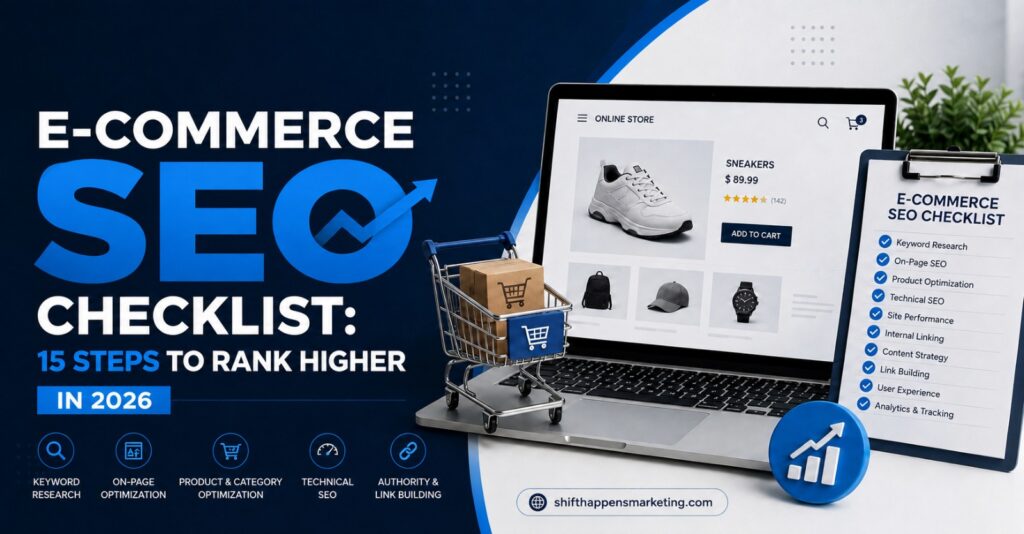
Most online stores lose organic traffic before a single blog post gets written. Thin category pages, duplicate product URLs, and a slow checkout flow do more damage than a missing keyword ever will. If your store isn’t ranking the way it should, the fix is rarely one big move. It’s a series of specific, sequenced changes. This e-commerce SEO checklist walks through 15 steps in the order they should actually be tackled: audit first, fix the technical foundation, then build out the category, product, and content pages that both Google and AI answer engines can trust. Work through it in order, and you’ll know exactly where your store stands and what to fix next. What Is E-Commerce SEO? E-commerce SEO is the process of optimizing an online store’s technical structure, category pages, product pages, and content so it ranks higher in search engines and AI-generated answers. Unlike SEO for a small brochure site, it has to work at scale, across hundreds or thousands of URLs, without breaking crawlability or creating duplicate content along the way. That scale is what makes ecommerce SEO harder than most people expect. A single faceted navigation setup (filtering by size, color, or price) can generate thousands of near-duplicate URLs from one category. Get that wrong, and search engines waste their crawl budget on pages that will never convert a single sale. 1. Run a Full Technical SEO Audit Start with a full technical audit, because a broken crawl or indexing problem cancels out every other optimization on this checklist. Crawl your site with a tool like Screaming Frog, then cross-check the findings against Google Search Console. Look for orphan pages, duplicate title tags, broken internal links, and pages returning 404 or 500 errors. In practice, a misconfigured robots.txt file blocking an entire /collections/ or /products/ folder is one of the most common findings in ecommerce audits, and it’s often invisible until someone actually checks. 2. Fix Crawlability and Indexing Issues Once the audit is done, resolve what it found. Submit a clean XML sitemap to Google Search Console, fix any robots.txt rules blocking important pages, and confirm your category and product pages don’t carry an accidental noindex tag from a staging environment that never got removed. Check the Coverage report in Search Console weekly during this phase. New product pages should be indexed within days, not months. If they aren’t, that’s a crawlability problem worth chasing down before you write another word of content. 3. Improve Core Web Vitals and Page Speed Google uses Core Web Vitals as a page experience signal, with published thresholds of under 2.5 seconds for Largest Contentful Paint, under 200 milliseconds for Interaction to Next Paint, and under 0.1 for Cumulative Layout Shift. Ecommerce sites tend to miss these because of uncompressed product images, bloated third-party apps, and oversized hero banners on the homepage. Compress and lazy-load product images, audit which apps or scripts are actually earning their place on the page, and test your top templates (homepage, category, product) separately. A slow product page loses sales even when it ranks. 4. Research Keywords by Search Intent Before you touch a single page, map your keywords to the intent behind them. A search for “running shoes” is commercial investigation; a search for “best running shoes for flat feet” is closer to transactional; a search for “how to choose running shoes” is informational. Each one deserves a different page type. Build your keyword universe from Google autocomplete, the People Also Ask box, and your competitors’ ranking pages. Match content format to intent: category pages for commercial terms, buying guides for informational ones. If the SERP for a keyword is full of blog posts, don’t try to rank a product page for it. 5. Fix Duplicate Content and Canonical Tags Product variants (different colors, sizes, or bundle options) are the most common source of duplicate content on ecommerce sites. If each variant lives on its own URL, set canonical tags pointing to the primary product page, or consolidate variant traffic through URL parameters instead. The same applies to faceted navigation. Filtering by price or brand shouldn’t generate a new indexable URL for every combination. Left unchecked, this creates thousands of thin, near-identical pages competing against each other for the same keywords. 6. Optimize Category Pages With Unique Content Category pages usually carry more ranking potential than any single product page, because they target higher-volume, higher-intent commercial keywords. A bare grid of products with zero supporting copy gives search engines nothing to actually rank. Add 200 to 500 words of original introductory content above the product grid, covering what the category includes and how to choose between options. According to a 2026 content analysis by theStacc, a large share of ecommerce category pages still ship with no supporting copy at all, and pages that add even a short original introduction consistently outrank bare product grids for the same terms. 7. Optimize Product Page Titles, Meta Descriptions, and URLs Front-load the title tag with brand, product name, and the distinguishing variant (color, size, or model) within the first 60 characters. Never copy the manufacturer’s title tag directly; if every competitor selling the same item uses identical text, Google has no reason to rank yours first. Write a unique meta description for every product, and keep URL slugs short, lowercase, and free of tracking parameters. A URL like /mens-trail-running-shoes will always outperform an auto-generated string of IDs and query parameters. 8. Write Unique, Detailed Product Descriptions Manufacturer boilerplate copied across dozens of competing stores is one of the fastest ways to stay invisible. Write descriptions that answer the questions a shopper would actually ask before buying: sizing and fit, materials, compatibility, and how or when to use the product. Longer, narrative product copy tends to outperform a bare bullet list for informational queries, because it gives search engines and AI answer engines actual sentences to extract. Keep bullet points for specs, but back them up with real paragraphs. 9. Add Structured Data (Schema Markup)
SEO for Real Estate Agents in Texas: 7 Strategies That Work

Most home buyers and sellers in Texas start their search online long before they call an agent. They compare neighborhoods, browse listings, watch video tours, and increasingly ask AI tools for recommendations before ever picking up the phone. If your website is not showing up during that research phase, you are losing motivated leads to agents who invested in real estate SEO in Texas before you did. This guide covers seven strategies that are actually working for Texas agents, brokers, and small agency teams right now, from Dallas-Fort Worth down to Austin and San Antonio. Why Real Estate SEO in Texas Is Its Own Challenge Texas is not one real estate market. It is dozens of hyper-local ones layered on top of each other, each with its own MLS board, its own buyer behavior, and its own competitive landscape. A Frisco buyer searching for homes behaves differently than a buyer looking in Southlake fifteen minutes away, and Zillow and Realtor.com already dominate the broad, citywide search terms. The real opportunity for individual Texas agents is not out-ranking Zillow for “homes for sale Dallas.” It is owning the specific suburbs, neighborhoods, and buyer questions the big portals cover only in generic terms. With that in mind, here are the seven strategies that consistently move the needle. 1. Target Suburb and Neighborhood-Level Keywords, Not Just City Names Texas metro areas are enormous, and search behavior reflects that. Buyers do not search “Dallas real estate,” they search “homes for sale in Frisco with a pool” or “Southlake neighborhoods with good schools.” Agents who build content around this level of specificity consistently outperform agents chasing broad, high-competition city terms. A practical approach: 2. Get Your IDX and MLS Integration Technically Right IDX (Internet Data Exchange) integration lets your website display live MLS listings, and it is non-negotiable for any serious Texas real estate website in 2026. But IDX also creates real technical SEO challenges. Poorly configured IDX feeds are a common reason real estate websites struggle to rank at all. Things worth checking on your site: If your website platform makes this hard to control, it is worth evaluating whether a well-built WordPress site with a strong IDX plugin, would serve your long-term SEO goals better than an all-in-one platform with limited customization. 3. Build Content That Targets Both Informational and Commercial Search Intent Real estate SEO in Texas works best when your content strategy covers the full buyer and seller journey, not just “homes for sale” pages. That means combining commercial-intent content, the kind that is close to a lead, with informational content that builds trust earlier in the process. Strong content types to build out: 4. Optimize for AI-Powered Search, Not Just Traditional Rankings As AI Overviews and AI search assistants become a bigger part of how people research real estate, structured content and strong E-E-A-T signals (Experience, Expertise, Authoritativeness, Trustworthiness) matter more than they used to. AI tools tend to pull from content that gives clear, direct answers and that comes from a source with visible credibility markers. Practical steps for real estate agent website SEO in this direction: 5. Build Local Authority Through Genuine Link Building As a location-based business, local authority signals carry real weight for real estate SEO in Texas. Backlinks from locally relevant, trustworthy sources tell Google your business is a genuine part of the community, not just a website targeting keywords. Effective, realistic ways to build this over time: 6. Treat Your Google Business Profile as a Core SEO Asset, Not an Afterthought For agents who work a defined local territory, a fully optimized Google Business Profile directly affects whether you show up in local map results when someone searches “real estate agent near me” or “realtor in [neighborhood].” This includes accurate categories, complete service area information, regularly updated posts, and consistent responses to reviews. Review management matters here in the same way it matters for AI search: consistent, recent, genuine reviews are one of the clearest trust signals available to both Google and AI-driven recommendation tools. 7. Make Mobile Experience and Page Speed a Priority Most real estate research in Texas metro areas now happens on a phone, often while someone is between showings or comparing listings on the go. A slow, clunky mobile experience costs you leads regardless of how strong your content and rankings are. Prioritizing fast-loading listing pages, simple navigation, and mobile-friendly lead capture forms is not a nice-to-have anymore. It is a baseline requirement for real estate agent website SEO to actually convert the traffic it earns. How Long Does Real Estate SEO Take to Work in Texas? Most agents and brokerages start seeing measurable improvement within three to six months, though this varies with how competitive your specific market is and how much existing authority your website already has. Dense metro markets like Houston, Dallas, and Austin typically take longer to see movement than smaller Texas markets with less established competition. Frequently Asked Questions What is the most important SEO strategy for real estate agents in Texas? Targeting neighborhood and suburb-level keywords tends to deliver the fastest, most sustainable results, since Zillow and Realtor.com already dominate broad citywide search terms, but individual suburbs and neighborhoods remain genuinely winnable for local agents. Do real estate agents in Texas need IDX integration for good SEO? Yes. IDX integration is essential for displaying live MLS listings, but it needs to be set up carefully to avoid duplicate content and slow page speeds, both of which can hurt search rankings. How does AI search change real estate SEO in Texas? AI tools like Google’s AI Overviews increasingly pull direct answers from content that clearly addresses specific buyer and seller questions, so structured, question-based content and visible credibility signals matter more than they used to. Is local link building still worth it for realtor marketing in Texas? Yes. Backlinks from Chamber of Commerce listings, regional Realtor associations, local media, and community organizations remain a strong local authority signal for search engines and AI tools
Georgetown, TX Digital Marketing Trends for 2026

Georgetown has spent several recent years as one of the fastest-growing cities in the entire country, and that growth is reshaping what digital marketing in Georgetown, TX actually needs to look like in 2026. Between the Sun City retirement community on the north side, new family neighborhoods like Wolf Ranch and Berry Creek, and constant overflow from Austin along the I-35 and SH 130 corridors, Georgetown is not one market. It is several overlapping markets, and the businesses winning online in 2026 are the ones treating it that way. Here is what is actually changing for Georgetown, TX digital marketing this year, and what small businesses in Williamson County should be doing about it. Trend 1: AI-Powered Search Is Now a Real Discovery Channel The biggest shift in 2026 is not a new social platform; it is where people start looking. A growing number of Georgetown residents are asking ChatGPT, Google’s AI Overviews, or Gemini questions like “who is a good roofer near Wolf Ranch” instead of typing a traditional search. The AI tool answers with a short list of specific businesses, and if you are not one of them, you are effectively invisible to that search. This practice, often called Generative Engine Optimization (GEO) or Answer Engine Optimization (AEO), overlaps with traditional SEO but rewards different things. AI engines tend to favor: For a Williamson County small business, this means restructuring at least some site content around direct questions and direct answers, rather than only broad service pages. Trend 2: The Sun City Effect Is Changing Local Search Behavior Georgetown’s demographics are unusual for a fast-growing Austin-metro suburb. The Sun City retirement community means a disproportionate share of local demand is senior-oriented: home modifications, accessible remodeling, senior care, and medical services all see stronger-than-typical demand here compared to younger-skewing neighbors like Leander or Hutto. That has a direct marketing implication. Trust signals, such as years in business, a strong BBB rating, and a high review count, tend to carry more weight with this audience than they do in younger markets. If your Georgetown digital marketing strategy leans entirely on flashy short-form video, you may be missing a large and high-spending segment of your actual customer base. A balanced approach that pairs modern content with clear, credibility-focused website copy performs better across Georgetown’s full population. Trend 3: Hyper-Local Content Is Outperforming Generic City Pages A thin “we serve Georgetown” page padded with the city name repeated a dozen times no longer moves rankings the way it once did. What is working in 2026 is genuinely useful, specific content, the kind that talks about common issues with Sun City-era HVAC systems, what older homes near the Historic District and the Square tend to need, or how new construction in Wolf Ranch changes what a homeowner should expect from a landscaping or foundation company. Google, and increasingly AI search tools, reward content that reads like it was written by someone who actually knows the town, not a template swapped in for every city an agency serves. If you serve multiple communities across Williamson County, such as Round Rock, Leander, Liberty Hill, Cedar Park, and Hutto, each deserves its own real page, not a copy-pasted variant. Trend 4: Mobile and Map Pack Behavior Continues to Dominate Most local searches in Georgetown happen on a phone, often from someone actively driving or about to leave the house. That makes page speed, accurate business hours, and structured local data more important than ever for map pack visibility. A slow-loading website or an out-of-date Google Business Profile listing can cost you the click even if your business is objectively the better fit. Trend 5: Review Volume and Recency Are Becoming a Ranking Signal, Not Just a Trust Signal It is no longer enough to have a strong star rating from two years ago. Search engines and AI tools are increasingly weighing how recent and how frequent your reviews are, since a steady stream of new reviews signals an active, currently operating business. For Georgetown businesses competing against national franchises with big marketing budgets, a consistent review generation habit is one of the most cost-effective advantages available. Trend 6: Bilingual Content Is a Growing Opportunity As Williamson County’s Hispanic population continues to grow, businesses that offer bilingual website content and Google Business Profile information are seeing a real edge in visibility and conversion, particularly for home services, healthcare, and retail. This is still an underused strategy among Georgetown small businesses in 2026, which makes it a genuine opportunity rather than a crowded tactic. Trend 7: Local Link Building Through Community Involvement Still Works Digital does not mean disconnected from the physical community. Links and mentions from the Georgetown Chamber of Commerce, the Downtown Georgetown Association, and coverage tied to community events like the Red Poppy Festival continue to carry real weight for local search authority. These are exactly the kind of trust signals that both traditional SEO and AI-driven search tools use to decide which local businesses to recommend. Frequently Asked Questions What is the biggest digital marketing trend in Georgetown, TX for 2026? The shift toward AI-powered search, including tools like ChatGPT and Google AI Overviews, is the biggest change. Businesses now need content structured to directly answer specific customer questions, not just rank for keywords. Does Georgetown’s Sun City community change how businesses should market? Yes. Sun City brings a large senior demographic to Georgetown, and this audience tends to weigh trust signals like years in business, BBB ratings, and review volume more heavily than flashier marketing tactics. Is local SEO still important in Georgetown given how fast the city is growing? It is more important than ever. Rapid growth means new households are searching for local businesses every week, and mobile map pack results often determine which business gets the first call. Should Georgetown businesses create separate pages for Round Rock, Leander, and other nearby cities? Yes, if you genuinely serve those areas. Real, specific content for each community performs far better than
Killeen, TX Small Business Marketing: Where to Start
If you own a small business in Killeen and you are not sure where to put your next marketing dollar, you are not alone. Killeen is a city of more than 153,000 people, home to one of the largest military installations in the world. That single fact changes almost everything about how small business marketing in Killeen, TX should work, and it is why strategies built for a typical mid-size Texas city often fall flat here. This guide walks through exactly where to start, in the order that actually moves the needle for a Killeen small business, whether you run a restaurant off Rancier Avenue, a repair shop near Stan Schlueter Loop, or a service business that covers the whole Fort Hood area. Why Killeen Marketing Is Different From Other Texas Markets Most local SEO advice assumes a stable population that slowly grows year over year. Killeen does not work that way. Fort Hood supports well over 36,000 active-duty soldiers plus tens of thousands of family members, civilian employees, and contractors, and a meaningful share of that population turns over every one to three years through PCS (permanent change of station) moves. That creates two realities for local business owners: Understanding this is the real starting point. Everything below is built around marketing to a population that is always partially new. Step 1: Claim and Fully Optimize Your Google Business Profile For most Killeen small businesses, this is the single highest-leverage marketing move available, and it costs nothing but time. This step centers on your Google Business Profile. Search behavior in Killeen skews heavily toward “near me” and map-based searches, especially from military families who just moved to the area and are searching directly from their phones. A complete, accurate Google Business Profile is what shows up in that map pack. To do it right: Post updates at least weekly. Businesses that post regularly signal activity to Google, and activity is a trust signal in a market with high turnover. Step 2: Build Local Content That Answers What New Residents Are Searching New households arriving near Fort Hood are actively searching for things like “best HVAC company near Fort Hood,” “family dentist Killeen TX,” or “moving companies Killeen Fort Hood.” If your website does not have a page or blog post that speaks directly to that search, a competitor does. This step is about building local content. Effective local content for a Killeen business includes: Step 3: Get Your Business Listed and Cited Consistently Citation consistency, meaning your business name, address, and phone number match exactly across every directory, matters more in a market where new residents are actively comparing unfamiliar businesses. Make sure your information is accurate and identical on: Military-focused resources like installation newcomer guides and spouse Facebook groups, which function as informal but powerful local citations Step 4: Take Reviews Seriously Reviews carry extra weight in Killeen because so many customers are choosing a business for the first time with zero personal history in the area. A strong, recent review count often outweighs brand recognition. Ask every satisfied customer for a review, respond to all of them (good and bad), and do it consistently rather than in one big push. A steady drip of recent reviews signals an active, trustworthy business, which matters both to human searchers and to AI-driven search tools that increasingly summarize businesses based on review content. Step 5: Use Social Media Where Your Actual Customers Are Facebook remains disproportionately important in Killeen because of active local groups built around Fort Hood life, spouse networks, and PCS advice. A local business that shows up helpfully in these communities, rather than just running ads at them, tends to build trust faster than in most civilian markets. This is where a broader social media presence pays off. Instagram and TikTok work well for restaurants, retail, and personal services targeting the under-35 demographic that makes up a large share of the active-duty population. Step 6: Consider Paid Search for Immediate Demand Because so much of the customer base is brand-new to the area at any given time, paid search (Google Ads) can perform unusually well in Killeen. New residents have no existing brand loyalty, so a well-targeted ad for “emergency plumber Killeen TX” or “car dealership near Fort Hood” can convert a customer who has never heard of you before. This is worth testing even on a modest budget once your Google Business Profile and website foundation are solid. Step 7: Decide Whether to DIY or Hire a Killeen Marketing Agency Some of the steps above, especially Google Business Profile setup, review requests, and basic local content, are manageable in-house with a few hours a week. Others, like ongoing SEO, paid ad management, and website structure, tend to benefit from working with a Killeen marketing agency or a Fort Hood area business marketing specialist who understands the PCS-driven customer cycle. If you are spending more time guessing than executing, that is usually the signal it is time to bring in help. Frequently Asked Questions Where should a small business in Killeen start with marketing? Start with your Google Business Profile. It is free, it is what most new residents use to find local businesses on their phones, and a fully optimized profile typically produces results faster than any other single step. Why is marketing different in Killeen compared to other Texas cities? Killeen’s population turns over constantly because of Fort Hood PCS cycles. Businesses cannot rely on long-term word of mouth the way they might in a stable market, so consistent visibility, reviews, and local content matter more year-round. Is paid advertising worth it for a small business in Killeen? Often yes, especially because new residents have no existing brand preferences. Paid search can be a fast way to capture customers who are actively searching but have never heard of your business. How important are online reviews for Killeen businesses? Very important. New residents rely on reviews to evaluate unfamiliar businesses, and a steady stream of
How Much Does a Digital Marketing Agency Cost in Houston, TX?

Three Houston agencies, three wildly different quotes: $1,200 a month, $4,500 a month, and one that won’t name a number until after a “discovery call.” That spread is normal, and it’s also useless if you don’t know what you’re actually comparing. Houston is one of the largest and most fragmented marketing agency markets in Texas. You’ve got boutique shops run out of the Heights, mid-size firms serving the Energy Corridor, and national agencies with a Houston office, and pricing can swing 5-10x for what looks like the same scope of work on paper. This guide breaks down what Houston businesses actually pay in 2026 by service type, what’s driving the spread, and how to tell if a quote in front of you is fair before you sign anything. Digital Marketing Agency Cost in Houston: The 2026 Numbers Service Typical Monthly Cost (2026) Notes Local SEO + GBP package $1,000 – $5,000/mo Best fit for single-location Houston businesses relying on map-pack and “near me” traffic Full organic SEO $1,500 – $10,000/mo (most legitimate work falls $2,500-$7,500) Content, technical SEO, link building PPC / Google Ads management $1,500 – $5,000/mo flat, or 10-20% of ad spend Management fee only; excludes actual ad spend Social media management $1,000 – $4,000/mo Scales with platform count and posting cadence Full-service multichannel $3,500 – $8,000/mo SEO + PPC + social + content combined Website design (one-time) $3,000 – $30,000+ project fee Varies with page count, e-commerce, custom design Hourly consulting $100-$300/hr boutique, up to $500/hr enterprise Best for one-off audits or strategy sessions Why Digital Marketing Agency Pricing Swings So Much in Houston A boutique agency might quote $1,500 a month for SEO while an enterprise firm quotes $15,000 for what looks like similar scope. The gap is rarely about quality; it’s overhead, geographic cost structure, and client-size expectations. Houston compounds this because the market is genuinely split in two: energy, industrial, and B2B companies with longer sales cycles and more competitive, higher-value keywords, versus local service businesses clinics, restaurants, home services competing mainly for map-pack and “near me” visibility on tighter budgets. A useful rule of thumb: small businesses generally allocate 3-5% of annual gross revenue to marketing. A Houston business doing $1 million in annual revenue lands at roughly $2,500-$4,200 a month, which is a more grounded starting point than any agency’s advertised “starting at” price. What a Google Business Profile & Nearby-Search Package Costs in Houston Since Google Business Profile signals control 32% of local pack ranking weight, more than any other category, most Houston “local” packages are essentially priced around GBP optimisation and review generation, not broad organic SEO. A typical local/GBP package includes profile optimisation and category management, ongoing GBP posts, review generation and response management, and local citation building across directories. How much you need to spend here depends heavily on which part of Houston you’re competing in. Denser, higher-competition areas like the Galleria, Midtown, and the Heights tend to require a heavier review-and-citation investment to clear the AI citation threshold of roughly 150 reviews per location, below which AI tools like ChatGPT and Gemini rarely surface a business in a nearby recommendation at all. Businesses in less saturated Houston-metro suburbs Katy, Pearland, Sugar Land can often win nearby searches with a lighter, less expensive package. SEO and PPC Cost Breakdown for Houston Businesses SEO retainers in Houston follow the same national pattern: advertised ranges start around $500 and top out over $25,000, but the range where legitimate ongoing work actually happens is $1,500-$10,000 a month, with $2,500-$7,500 covering most established small and mid-size businesses. PPC management is priced two ways: a flat monthly fee ($1,500-$5,000) or a percentage of ad spend (typically 10-20%). Houston’s metro-level competition for Google Ads keeps cost-per-click higher than in smaller Texas markets, which is part of why many agencies default to percentage-of-spend pricing for larger Houston accounts: it scales the fee with the complexity of managing a bigger budget rather than locking in a flat rate that may not cover the work. Hidden Costs That Change Your Real Houston Agency Bill How to Evaluate a Houston Digital Marketing Agency Quote Ask exactly what’s included in reporting and how often you’ll get it; vague reporting is a common way scope quietly shrinks. Agency Tier Typical Hourly Rate Best Fit Boutique $100-$300/hr Small Houston businesses, single-service engagements Mid-tier $125-$275/hr Growing, multi-location Houston businesses Enterprise $175-$500+/hr Large accounts with substantial ad budgets DIY vs. Hiring a Houston Digital Marketing Agency: Cost-Benefit Factor Managing It In-House Hiring a Houston Agency Cash cost Lower direct cost, higher staff time cost $1,000-$8,000+/mo depending on scope Expertise access Limited to what your team already knows Access to specialists across SEO, PPC, content Speed to results Slower without dedicated focus Faster with an established process and tools Accountability Internal only Contractual deliverables and reporting FAQ: Digital Marketing Agency Costs in Houston, TX What’s a fair starting budget for a small Houston business? A $1,000-$3,000/mo local package covering Google Business Profile optimisation, review generation, and basic on-page SEO is a reasonable entry point for a single-location business. Is percentage-of-ad-spend or flat-fee PPC pricing better for a Houston business? Below roughly $5,000-$10,000 a month in ad spend, a flat management fee is often cheaper; above that threshold, percentage-based pricing tends to better reflect the added complexity of managing a larger budget. Do Houston agencies charge more than agencies in smaller Texas cities? Generally yes, driven by higher overhead and more competitive keyword markets, though it isn’t universal, and boutique Houston shops can still price competitively against agencies in smaller metros. The number on a Houston agency’s pricing page rarely tells you what you’ll actually pay. Get the breakdown by service, ask what’s excluded, and size your budget against your revenue, not against the lowest quote you’ve received.
Local SEO for Austin, TX Businesses: The Complete Guide to Ranking in the Map Pack

If you own a business in Austin, you’ve probably noticed something frustrating: you can have a beautiful website, great reviews, and a solid product and still be invisible when someone types “[your service] near me” into Google. Meanwhile, three competitors you’ve never heard of are sitting in the map pack, soaking up the calls and walk-ins that should be yours. That gap is rarely about your product. It’s about local SEO, and in Austin specifically, the rules of that game are tighter than most business owners realize. Why Local SEO Matters More in Austin Right Now Than Almost Anywhere Else Austin isn’t a quiet market to rank in anymore. In early 2026, Austin was named the fastest-growing city in the country for small business formation, ahead of Miami, Phoenix, Nashville, and Tampa, based on new business applications, employment growth, and commercial permitting activity. Texas as a whole is now home to roughly 3.5 million small businesses, and Austin is absorbing a disproportionate share of that growth as workers and companies continue relocating from California and the Northeast. What that means in practice: for almost every service category HVAC, dentists, law firms, salons, contractors, gyms the number of businesses competing for the same “near me” searches in Austin is growing every quarter. The businesses that show up in the map pack today aren’t necessarily the best ones. They’re the ones whose Google Business Profile and local signals are structured correctly. How Google Actually Decides Which Austin Businesses Show Up in the Map Pack Google’s local algorithm weighs three core factors, and understanding how they interact is the difference between guessing and actually improving your ranking. Ranking Factor What It Means How It Plays Out in Austin Proximity How close the business is to the searcher at the moment they search A business in South Congress won’t rank for a searcher in Round Rock, no matter how optimised the profile is. This is why single-location businesses need hyperlocal content, not just city-wide keywords Relevance How well your profile and website match the intent of the search Category selection, services listed, and the specific wording in your GBP description and website copy all feed this Prominence How well-known and well-reviewed the business is, both online and off Review volume, review recency, citation consistency, and backlinks from other Austin-area sites all contribute here Google Business Profile signals alone account for roughly a fifth of total local ranking weight, which is why it’s usually the highest-leverage, lowest-cost place to start. The Google Business Profile Checklist Every Austin Business Needs Most Austin businesses have a Google Business Profile. Very few have one that’s actually built to win the map pack. Run through this list: ● Primary category is exact, not close enough. “Dentist” and “Cosmetic Dentist” pull different results; pick the one that matches what you actually want to rank for. ● All applicable secondary categories are added, not just the primary one. ● NAP (Name, Address, Phone) matches exactly across your website, GBP, and every directory (Yelp, Apple Maps, Bing Places, industry directories). Inconsistent NAP data is one of the most common reasons Austin businesses plateau in rankings. ● Service area is set correctly if you serve surrounding suburbs like Round Rock, Cedar Park, or Pflugerville, rather than relying on Austin alone to catch that traffic. ● Photos are added and refreshed monthly. Profiles with quality photos see more direction requests than those without. ● The Q&A section is seeded and monitored; most businesses ignore this, which means the few that use it stand out. ● Messaging is turned on. Listings with messaging enabled see noticeably higher lead volume than those relying on phone calls alone, and a growing share of consumers now prefer messaging over calling entirely. ● Posts go out weekly, not just when someone remembers to do it. What Happens After an Austin Customer Runs a “Near Me” Search This is the part most local SEO content skips, and it’s the part that should actually change how you prioritise your marketing budget. Behaviour After a “Near Me” Search Share of Searchers Visit the business within 24 hours 76% Visit or call within one week (mobile searchers) 88% Search results in an actual purchase 28–31% Searches happen on a mobile device 70%+ Users are more likely to call if the site is mobile-friendly 61% The takeaway: a near-me search isn’t a casual browse; it’s someone who has already decided to buy and is now choosing who from. If your profile is incomplete or your site is slow on mobile, you’re not losing a curious visitor. You’re losing a customer who was ready to pay someone today. Austin-Specific Local SEO Mistakes That Cost Businesses Rankings Austin-Area Submarket Local SEO Note Downtown / East Austin Highest competition, tech and hospitality heavy; differentiation through reviews and response speed matters most South Congress / Zilker Strong local-brand loyalty; neighbourhood-specific content and imagery outperform generic city-wide copy The Domain / North Austin Corporate and retail-adjacent searches; commercial-intent keywords convert better than informational ones Round Rock / Cedar Park Lower competition than Austin proper, but growing fast an underused opportunity for service businesses willing to add dedicated location pages Pflugerville / Manor Rapid residential growth with comparatively thin local search coverage early movers can rank faster here Treating “Austin” as one market. Austin isn’t a single competitive zone; it’s a cluster of submarkets, each with different competition levels and different customer expectations. Businesses that build even brief, genuinely useful content around these submarkets, rather than repeating “Austin, TX” on every page, consistently outrank competitors who only optimise for the city name. Ignoring review velocity. A 4.8-star profile with two reviews from 2023 loses to a 4.3-star profile getting five new reviews a month. Recency signals activity, and Google (and customers) both weight it heavily. No local link building. Backlinks from Austin-based sources chambers of commerce, local news, sponsorships, business associations carry more local relevance weight than generic national directories. Frequently Asked Questions How long does local SEO take to work in Austin? Most businesses